
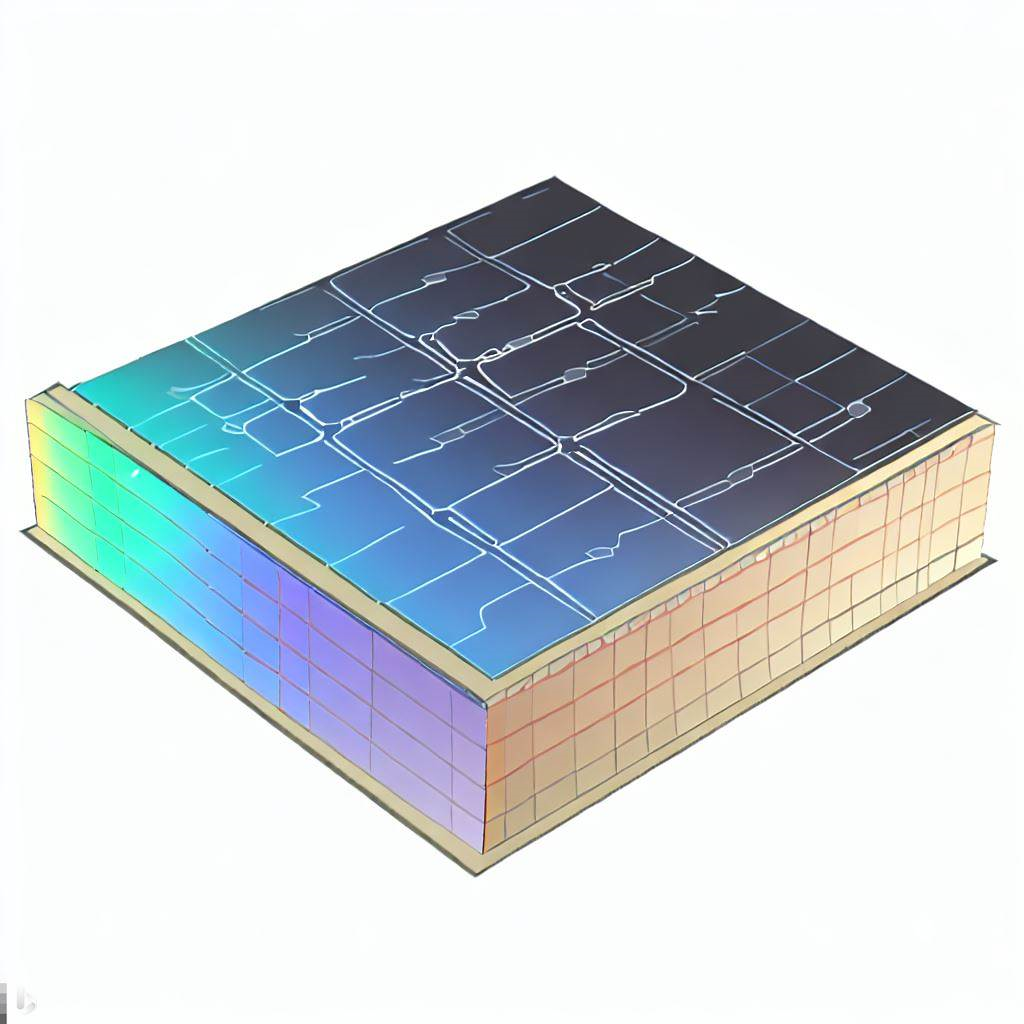
Perovskite solar cells are a type of solar cell that includes a perovskite-structured compound, most commonly a hybrid organic-inorganic lead or tin halide-based material, as the light-harvesting active layer. They have shown remarkable progress in recent years with rapid increases in efficiency, from reports of about 3% in 2009 to over 25% today.(1) Perovskite solar cells can be manufactured using simple, additive deposition techniques, like printing, for a fraction of the cost and energy of traditional silicon solar cells. Because of the compositional flexibility of perovskites, they can also be tuned to ideally match the sun’s spectrum.
Perovskite solar cells are thin-film devices built with layers of materials, either printed or coated from liquid inks or vacuum-deposited. Producing perovskite solar cells is a relatively simple process, which makes them an attractive option for commercialization. However, a number of challenges remain before they can become a competitive commercial technology. One of the main challenges is their stability, which is limited compared to leading photovoltaic technologies. Perovskites can decompose when they react with moisture and oxygen or when they spend extended time exposed to light, heat, or applied voltage.
To increase stability, researchers are studying degradation in both the perovskite material itself and the surrounding device layers. Perovskite crystals often exhibit atomic-scale defects that can reduce solar conversion efficiency. Researchers have developed “passivation” techniques, treating perovskites with different chemical compounds to heal these defects. Current issues with perovskite solar cells revolve around stability, as the material is observed to degrade in standard environmental conditions, suffering drops in efficiency. Despite these challenges, perovskite solar cells have become commercially attractive due to their potential of achieving even higher efficiencies and very low production costs.
Researchers are working to improve the intrinsic stability of the perovskite absorber layer, design architecture of the device, and search for new durable materials.(2) Understanding the degradation mechanisms is important before exploring remedies for degradation.(3) Researchers are studying degradation in both the perovskite material itself and the surrounding device layers. To increase stability, researchers are developing “passivation” techniques, treating perovskites with different chemical compounds to heal defects.
Passivation techniques are used to treat perovskite materials to reduce defects and improve the stability of perovskite solar cells. The passivation techniques in the perovskite layer are categorized as passivation of grain boundaries, passivation of point defects, surface passivation, etc.(4) Surface passivation methods using 2D perovskites can be divided into four general methods: solution processing, immersion processing, vacuum deposition, and in situ growth.(5) The passivation material significantly reduces the defects and non-radiative recombination between the perovskite active layer and the adjacent layers.(6) Post-treatment of a perovskite film is known to be an efficient way to passivate surface defects in perovskite solar cells (PSCs) . One of the promising approaches is introduced here. Conventionally, post-treatment with organic iodides has been performed on the annealed perovskite phase which, however, forms undesirable excess iodides on the surface that can generate interstitial iodine defects causing poor stability. Here, an efficient post-treatment process is reported that is performed on the as-deposited un-annealed intermediate phase . This method enables an effective passivation of the perovskite film surface with a minimal organic iodide passivation agent (100-fold reduced concentration compared with the conventional method) to prevent the surplus iodides.(6)
(1) J. Am. Chem. Soc. 2009, 131, 17, 6050–6051.
(2) Organic Electronics, 2020, 78, 105590.
(3) Front. Electron., 2021, 2, DOI: 10.3389/felec.2021.712785.
(4) Materials Science for Energy Technology, 2021, 4, 282.
(5) Advanced Materials, 2022, 34, 2105635.
(6) J. Materials Chemistry A, 2021, 9, 3441.
 RenewTech Chronicles
Leave a comment