
Offshore wind farms are an important source of renewable energy, and there is ongoing research and development to improve their efficiency and sustainability. The report highlights that global offshore wind installations in 2021 had a record year for deployment with 17,398 MW of new projects commissioned, pushing global installed capacity past 50 GW. The industry continues its trend toward larger turbines to reduce per-megawatt project costs. The average offshore wind turbine capacity installed in 2021 was 7.4 MW, (1) which is much larger compared with the general on-shore capacity, 2.5-3 MW and land-based wind turbine, 1-5 MW. (A wind turbine with about 1 megawatt of power can produce enough clean energy for about 300 homes each year.)
The National Renewable Energy Laboratory (NREL) conducts offshore wind turbine research that focuses on controls, reliability, resource assessment, testing, modeling, and simulation. In August 2022, the U.S. Department of Energy Wind Energy Technologies Office released the Offshore Wind Market Report: 2022 Edition, which was co-authored by several researchers at NREL. The report details information on the global and domestic offshore wind industry to provide current-state data and trends to help readers navigate technical and market barriers and opportunities. NREL’s current projects include aerodynamic turbines lighter and afloat with nautical technologies and systems engineering and optimization of next-generation floating wind turbines, mooring systems, support structures, among others. (2)
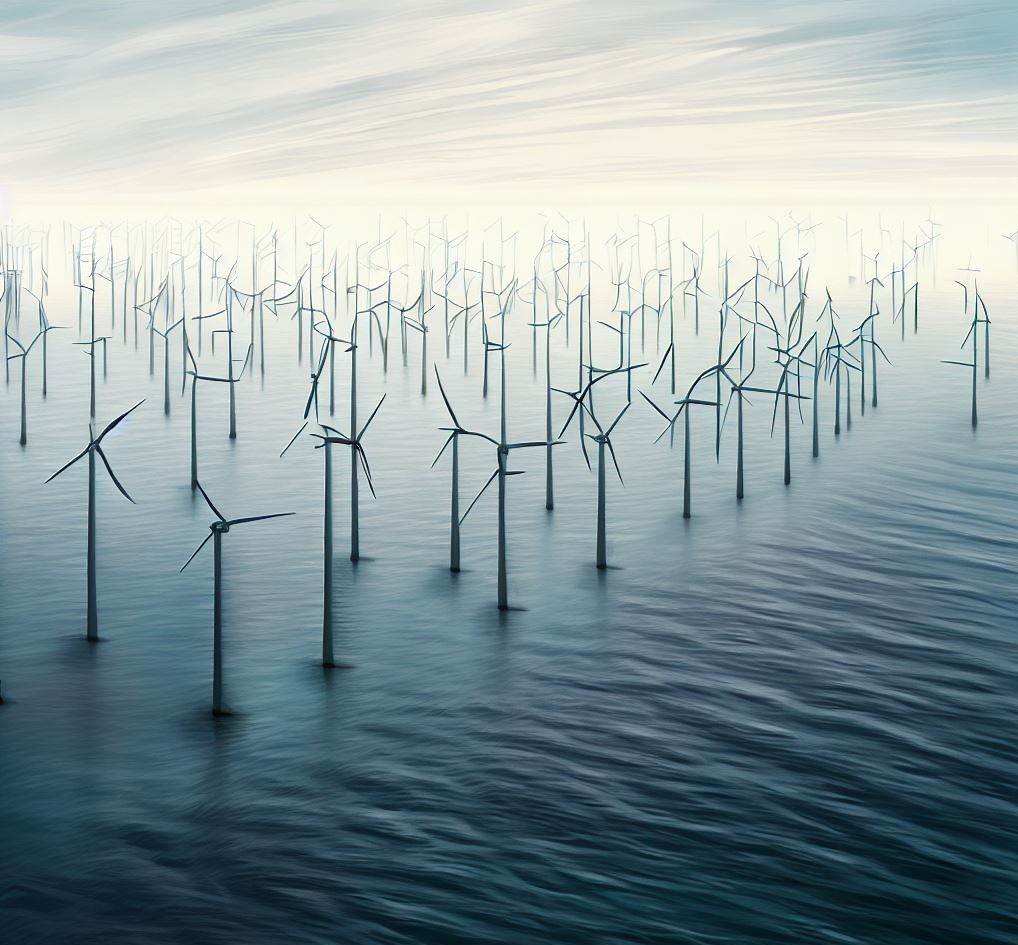
Offshore wind energy is widely regarded as one of the most credible sources for increasing renewable energy production towards a resilient and decarbonized energy supply. However, current expectations for the expansion of energy production from offshore wind may lead to significant environmental impacts. Assessing ecological risks to marine ecosystems from electricity production from wind is both timely and vital. Offshore wind farms (OWFs) already accounted for 10% of new wind power installations around the world in 2019 and are expected to contribute more than 20% of the total installed capacity of offshore wind electricity production by 2025. To attain this growth rate, the global installed capacity of offshore wind projects needs to increase almost tenfold by 2030 (to 228 GW) and continue to rise to 1000 GW by 2050. The ecological impacts of offshore wind farms are being reviewed by researchers to assess the risks to marine ecosystems from electricity production from wind. (3)
(1) https://www.energy.gov/eere/wind/articles/offshore-wind-market-report-2022-edition
(2) https://www.nrel.gov/wind/offshore-wind.html
(3) npj Ocean Sustain 1, 1 (2022). https://doi.org/10.1038/s44183-022-00003-5
 RenewTech Chronicles
Leave a comment