
Predictions indicate that global PV capacity will exceed 22 TW by 2050. Over 70% of solar energy incident on commercial photovoltaic panels is dissipated as heat, leading to decreased electrical performance. The efficiency of PV panels decreases significantly with increased operating temperature. High-efficiency and low-cost thermal management methods are necessary to enhance power generation from existing and future PV installations.
Active methods using water or air flows require complex structures, installation, and operational complexity. Passive methods, such as natural convection cooling and sub-bandgap reflection, have simpler structures but limited cooling rates. Advanced passive methods like radiative cooling and utilising atmospheric water have shown improved cooling performance.
In the recent report published in Nature Communications (1), a hybrid PV-leaf concept aims to co-generate electricity, heat, and clean water from the same pumpless solar collector. The PV-leaf incorporates a biomimetic transpiration structure inspired by plant leaves. Transpiration is the process by which plants lose water in the form of vapor through their leaves. It plays a crucial role in the overall water cycle and helps plants to regulate their temperature and maintain their shape. Bamboo fibres and hydrogel cells attached backside of the PV cells are used to mimic the natural transpiration process. The transpiration structure effectively removes heat from the PV cell and adapts to different working fluids.
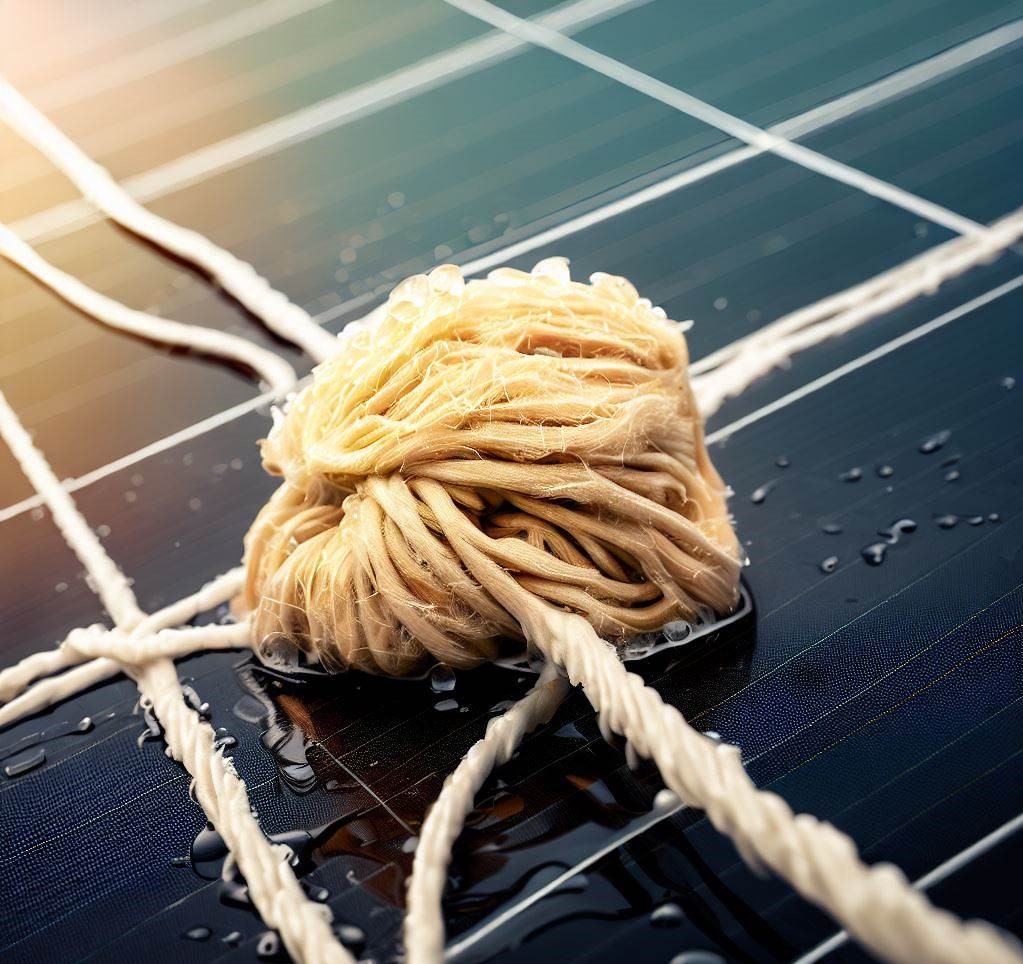
Experimental results show that the PV-leaf can remove 75% (590 W/m) of heat from the PV cell, reducing the operating temperature by ~26 °C. The PV-leaf has a high solar utilization efficiency of 74.5%, about 5-6 times that of a standalone PV cell. The biomimetic transpiration structure is made from affordable, readily-available, and environmentally-friendly materials.
The PV-leaf consists of a biomimetic transpiration layer attached to the back of a solar PV cell. Bamboo fibre bundles mimic vascular bundles for water transportation, while hydrogel cells provide effective evaporation. The PV-leaf configuration includes a biomimetic transpiration (BT) layer, supporting mesh, and PV cell layer.
Solar energy absorbed by the PV cell is converted into electricity and internal (thermal) energy. Heat conducts away from the PV cell to a superabsorbent polymer (SAP) hydrogel cells for thermal contact. Water in the SAP hydrogel cells evaporates, removing thermal energy. Continuous flow of liquid water from the water tank supplements the water lost by evaporation. PV-leaf temperature is significantly reduced compared to standalone PV cell. Transpiration rate reaches around 1.1 L/h/m. PV-leaf shows improved open-circuit voltage, fill factor, and electrical efficiency. Open-circuit voltage and electrical efficiency of the PV-leaf improved by 8.6% and 13.6% relative to standalone PV cell. Electrical efficiency of the PV-leaf improved by 10.2% at lower ambient temperature. PV-leaf transpiration removes a significant amount of heat, accounting for 56% of the total PV heat. PV-leaf can remove 590 W/m of heat from the PV cell. It can be utilized for saline via transpiration, which generates clean vapor that is effectively desalinated to produce clean water. This method not only uses transpiration, inspired by plant leaves, to cool the PV system and improve its efficiency, but also simultaneously produces clean water in the process.
PV-leaf removes heat from PV cell, improving electricity output by 14%, and it does not need for pumps, control units, expensive porous materials, and can cool target surface to lower temperature, suitable for multiple applications. It can also passively control transpiration rate for different ambient temperatures, and is compatible for utilizing seawater as working fluid. Synergistically this produces additional freshwater and useful thermal energy.
(1) Huang, G., Xu, J. & Markides, C.N. High-efficiency bio-inspired hybrid multi-generation photovoltaic leaf. Nat Commun 14, 3344 (2023). https://doi.org/10.1038/s41467-023-38984-7
 RenewTech Chronicles
Leave a comment